
The Fenland Ark
the floating church of St. Withburga
Page good for smart-phones. On PCs/Laptops it may look too large. To reduce press "Ctrl" & "minus" or click "View" then "Zoom out"
Created Mar 2013, last edited: 25/03/26, 09:03
Created Mar 2013, last edited: 25/03/26, 09:03

Foreword
March 2026 Page Upgrade
This page is under reconstruction following HTML and CSS code upgrades and changes from 2 or 3 columns to one responsive phone-friendly display.Inevitability, some images or text may be out of order or temporarily missing.
Introduction
 The
idea of a floating church was the brainwave of the Rev G Broke B.A., Rector
of Holme, near Peterborough. His parish included many farmsteads and small
isolated communities in newly-drained parts of the fens that had no roads
and were accessible only by rivers or 'drains' and he decided that if
worshippers could not easily get to the parish church then services had
to be taken to them instead.
The
idea of a floating church was the brainwave of the Rev G Broke B.A., Rector
of Holme, near Peterborough. His parish included many farmsteads and small
isolated communities in newly-drained parts of the fens that had no roads
and were accessible only by rivers or 'drains' and he decided that if
worshippers could not easily get to the parish church then services had
to be taken to them instead. It was sanctioned by the Bishop of Ely and built in 1897 in just two months by William Starling at Stanground for £70. It was a flat-bottomed lighter approx 30 feet long and 10 feet wide with a seven foot high superstructure, and towed by a horse, as were most fen craft.
It was dedicated by the Archdeacon in April 1897 to St. Withburga (variously said to be sister of St. Etheldreda of Ely and St Wendreda of March). Between then and October 1904 seventy-four baptisms took place around Holme. Special baptism cards were issued and people were very proud of the fact that they had been baptised on The Fenland Ark. A choir was made up from three families and bible classes and needlework classes for girls were held onboard.
In 1905 the parish priest at Manea, the Rev. F.G. Guy, having similar problems with communities along the Old Bedford River at Welches Dam, Purls Bridge and The Colony at Manea, acquired the barge to serve them. The Register of Manea Parish records three more baptisms, two at Welches Dam in 1905 and one, the very last, in 1906 at The Colony - that of Hazel Susie Feary. The houses at the Colony seem to have been vacated and demolished shortly afterwards.
Scroll down to follow the story or choose a section to jump to from the drop-down menu.
Inside the Fenland Ark

Inside it had an altar, a font, a lectern that served as the pulpit, a small American organ, a small vestry, and 34 chairs (some reports say it could accommodate up to 50 worshippers).
The Exterior
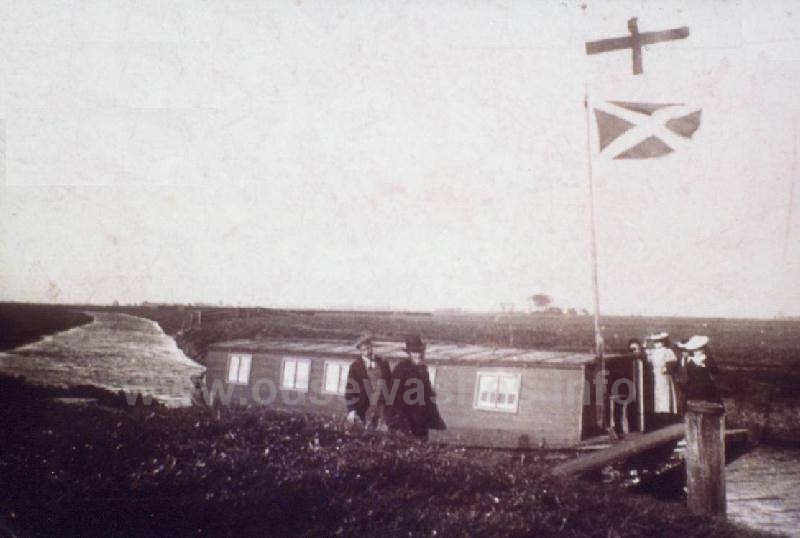
It didn't have a bell but it was customary to display two flags, those of St George and St Andrew, which could be seen at good distances across the flat Fens. The later was hoisted shortly before services commenced,.
Several large windows could be folded upwards to allow people on the bank to hear and take part in services.
Retirement
We don't know for sure what happened to the Fenland Ark after the Rev. Guy decided he no longer needed it following the departure of the last inhabitants at The Colony, but one report said it was converted into a houseboat in 1907 and given the name The Saints' Rest. Later it seems it deteriorated and about 1912 it apparently sank.Was our floating church unique?
In 1897 this fascinating church featured in an article in the Strand magazine which stated "the Floating Church of the Fens is unique, being the only one in the world."That may have been true, but it wasn't the first. More than half-a-century early, in 1843, the parishioners of Strontian in the Scottish highlands were refused permission by the land-owner to build a Free Presbyterian Church. So, the congregation clubbed together, bought a suitable vessel on Clydeside, had it converted into a church, and towed up the west coast of Scotland to a mooring nearby on Loch Sunart, where it became known as the Floating Church. This served the community until the 1870s. (From: Undiscovered Scotland: The Ultimate Online Guide). A drawing made by the shipbuilder John Reid and Co of Port Glasgow held in the collections of the Highland Folk Museum in Kingussie, near Aviemore, gives the church's dimensions: 78ft long, 23ft wide and 17ft high, built on two floors, but without a spire, it was constructed to hold about 400 people.
More information about the Ark's history

can be found in John Bennett's book: "The Fenland Ark : St Withburga’s – the floating Church of Holme and Manea", 3rd edition [Centenary edition 1897-1997] Holme Parish Church, 1997, ISBN 0950888400
Acknowledgements
Text and photos except where noted © Peter Cox, 2010-26If you think there are any errors or ommissions on this page or would like to comment, please e-mail me and your response will be added.