Page good for smart-phones. On PCs/Laptops it may look too large. To reduce press "Ctrl" & "minus" or click "View" then "Zoom out"
Created Mar 2013, last edited:
03/04/26, 17:04
Introduction
This watercourse is not actually part of the Ouse Washes but it is one of several where there are sufficient connections
to warrant some mention on this site.
It was mostly cut in 1651 during Vermuyden's second phase of drainage works in the Bedford
Level, running nearly 12 miles from a little way north of the Forty Foot River in the south to Popham's Eau
near Three Holes in the north. Contrary to many accounts, it doesn't seem to have been
connected to the Forty Foot River until the Middle Level Act of 1844 authorised that.
Most waterways in the Fens have more than one name, and this is no exception. It is show
on Thomas Badeslade's 1723 map as "Thurlos Drain" (or "Thurles Drain",
difficult to read the reduced size copy I've seen); the Middle Level Act of 1810 refers
to just "Sixteen Feet River"; and Samuel Wells in 1830 refers to both "Thurlow's Drain,
or Sixteen Feet River". On OS maps it was "Sixteen Foot River" in 1824 but since 1901
(at least) it has been "Sixteen Foot Drain", and I will use that later variation on this
page.
The drain is navigable but there are no public moorings. Unusually for fenland drains, ithas no
locks or sluices. It is a popular fishing venue,
notable for Zander.
Scroll down to follow the story or choose a section to jump to from the drop-down menu.
In c1844-8 the Middle Level Commissioners had a new channel, the Middle Level Main Drain,
cut from the northern end of the Sixteen Foot Drain (the line of Pohams Eau was changed
to allow for that) to Wigginhall St. Germans where the waters have to be pumped via a
huge pumping station (rebuilt 2011, and said to be one of the largest in Europe) up into the tidal Great
Ouse.
Oh, the connection that warrants inclusion on this site? Well, the Sixteen Foot Drain
connects to the Forty Foot River, which connected with the Old Bedford River/Counterdrain
(OBR/CD) via a lock at
Welches Dam until c2003. Since then, the limit of navigation has been Horseway Lock
where the Middle Level's responsibility ends and the EA's begins. The short
stretch from there to the OBR/CD has dried out and the lock at Welches Dam is closed and
sealed off. The EA say their part of the Fort Foot leaks, and the lock was unsafe.
Bridges
Name or location
MLC
ref
OS map ref
type
construction
built rebuilt
access
Bensons Fm
road
Mount Pleasant Br
road
Honey Br
road
Boots Br
31
TL 4459 9120
road
built by Isle of Ely County Ccl
1931
Pooles Br
road
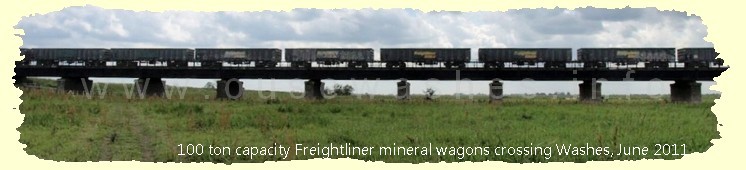
Railway bidge
rail
c1840s
1928?
Stone(a?) Br
road
Bedlam Br
17
TL 4679 9478
road
1968
to Chapel of Ease Fm
road
nr Wheatsheaf
road
Iron Br
road
Cotton Corner
road
During the late 1970s/early 1980s MLC did extensive works on the drain (as elsewhere in their district) and nine old bridges/culverts which were in poor condition and severely restricted flow, were demolished and replaced by eight new reinforced concrete structures.
Boots Bridge (MLC ref no 31)
OS map ref TL44599120
An OS Bench Mark, flush bracket S8411 is in the west end of the north parapet wall,
facing in.
Bedlam Bridge (MLC ref no. 17)
OS map ref TL46799478
Cotton Corner
Pumping Stations
From south to north
discharge from/to1
OS grid ref
built, power
output2 m3/s
owner (IDB)
TL
Slackers (Irigation inlets)
Pubs & Inns
Churches & Chapels
Most of the rivers and drains of East Anglia are listed and their
courses described on the "Wisbech and the Fenlands" website, which also
has a wealth of historical information about the area.

Sixteen Foot River
Created Mar 2013, last edited: 03/04/26, 17:04
Introduction
This watercourse is not actually part of the Ouse Washes but it is one of several where there are sufficient connections to warrant some mention on this site.
It was mostly cut in 1651 during Vermuyden's second phase of drainage works in the Bedford Level, running nearly 12 miles from a little way north of the Forty Foot River in the south to Popham's Eau near Three Holes in the north. Contrary to many accounts, it doesn't seem to have been connected to the Forty Foot River until the Middle Level Act of 1844 authorised that.
Most waterways in the Fens have more than one name, and this is no exception. It is show on Thomas Badeslade's 1723 map as "Thurlos Drain" (or "Thurles Drain", difficult to read the reduced size copy I've seen); the Middle Level Act of 1810 refers to just "Sixteen Feet River"; and Samuel Wells in 1830 refers to both "Thurlow's Drain, or Sixteen Feet River". On OS maps it was "Sixteen Foot River" in 1824 but since 1901 (at least) it has been "Sixteen Foot Drain", and I will use that later variation on this page.
The drain is navigable but there are no public moorings. Unusually for fenland drains, ithas no locks or sluices. It is a popular fishing venue, notable for Zander.
Scroll down to follow the story or choose a section to jump to from the drop-down menu.
Oh, the connection that warrants inclusion on this site? Well, the Sixteen Foot Drain connects to the Forty Foot River, which connected with the Old Bedford River/Counterdrain (OBR/CD) via a lock at Welches Dam until c2003. Since then, the limit of navigation has been Horseway Lock where the Middle Level's responsibility ends and the EA's begins. The short stretch from there to the OBR/CD has dried out and the lock at Welches Dam is closed and sealed off. The EA say their part of the Fort Foot leaks, and the lock was unsafe.
Bridges
ref
rebuilt
1928?
During the late 1970s/early 1980s MLC did extensive works on the drain (as elsewhere in their district) and nine old bridges/culverts which were in poor condition and severely restricted flow, were demolished and replaced by eight new reinforced concrete structures.
Boots Bridge (MLC ref no 31)
OS map ref TL44599120An OS Bench Mark, flush bracket S8411 is in the west end of the north parapet wall, facing in.
Bedlam Bridge (MLC ref no. 17)
OS map ref TL46799478Cotton Corner
Pumping Stations
m3/s
Slackers (Irigation inlets)
Pubs & Inns
Churches & Chapels
Most of the rivers and drains of East Anglia are listed and their courses described on the "Wisbech and the Fenlands" website, which also has a wealth of historical information about the area.
If you think there are any errors or ommissions on this page or would like to comment, please e-mail me and your response will be added.